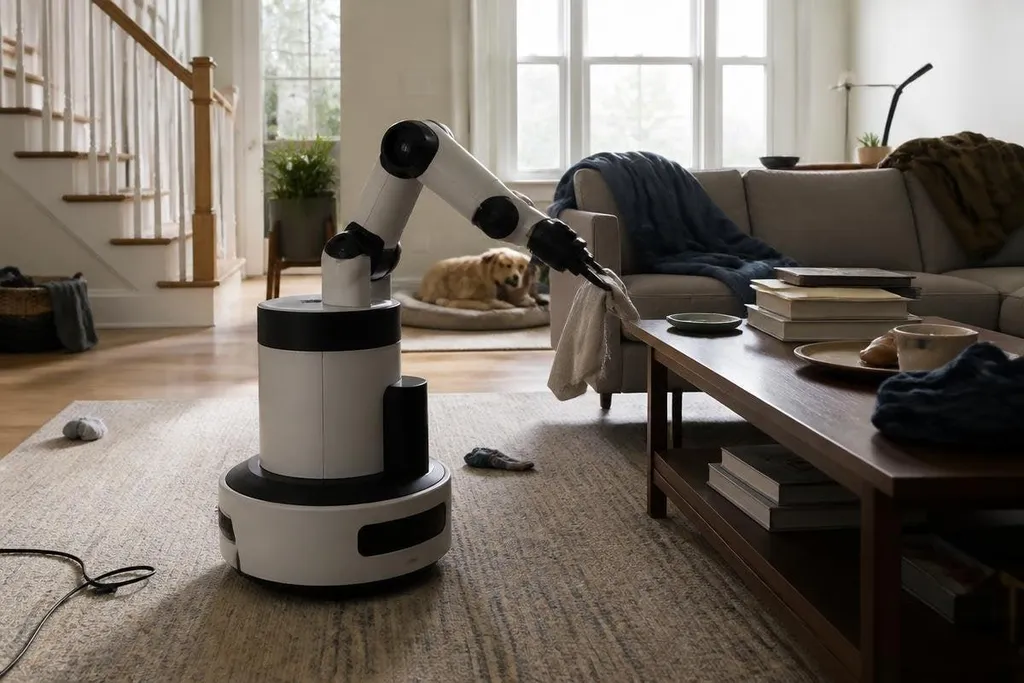
Home robots can see a room, move an arm, and answer a voice command. The hard part is getting one to finish ordinary chores safely, without a person watching every step. For a buyer, the real question is which tasks the robot can repeat in a messy home, not how smooth the demo looks.
Quick read
- Useful work starts with clear tasks, such as carrying laundry or picking up objects.
- Hands, safety sensors, and reliable home mapping matter more than a human-like shape.
- A robot that needs frequent remote help may shift work rather than remove it.
Why homes are harder than factories
Factories give robots marked floors, fixed shelves, steady lighting, and known objects. A home gives them stairs, rugs, pets, glass tables, loose cables, narrow spaces, and items left in the wrong place.
That difference changes the engineering problem. The system must first build a map of its surroundings. It then needs to spot objects, judge how to hold them, plan a safe route, and recover when something moves. A failure in any one step can stop the task.
The robot also needs to work around people. A slow arm can still hurt someone if it moves without checking the space around it. A useful home system needs force limits, emergency stopping, obstacle sensing, and a clear way for a person to take control.
The chores that matter
A machine does not need to do every household task to earn its space. It needs to handle a small group of jobs that take time, repeat often, and have a clear result.
Picking up toys is a good test because the objects vary in size and position. Moving laundry between a basket and a machine tests carrying, reach, and the ability to work near furniture.
Loading a dishwasher adds wet objects, tight gaps, and breakable items. Each task also needs a useful hand. A gripper that can lift a box may still fail with a sock, a spoon, or a thin plastic bag.
The hand must control force as well as position, since squeezing too hard damages the object and squeezing too lightly drops it. A voice interface can help, but speech alone doesn't solve the physical work. “Put this away” still requires the robot to know what “this” means and where it belongs.
The hidden cost of remote help
Many home robots will need a person to handle unusual cases. That may mean a remote operator guides the arm, labels an object, or takes over after the robot gets stuck.
Remote help can make early systems useful. It can also move the job to another person instead of removing it. Buyers should ask how often help is needed, how long each intervention takes, and what happens when the home has no reliable internet connection.
The internet question needs a second record: Robot24.com's reporting on home robots can connect a claim to a named system, test setting, and result. That helps you judge whether remote support is rare or part of the job. The next check is the full task, including mistakes and recovery.
The strongest proof will show complete tasks, including setup, mistakes, recovery, and the final result. A short clip of a robot lifting one cup tells you less than a full cleaning task recorded without cuts.
What still needs proof
The home robot market has several open tests. Makers need to show safe motion around children and pets, reliable work under changing light, and simple recovery when an object is missing or out of reach.
They also need to publish the limits. A robot may work on one floor but fail on stairs. It may carry a basket but lack the reach to load a shelf. A system that needs a clear room before starting may fit a lab better than a family home.
I’d skip any home robot whose maker shows polished clips but gives no task results, safety details, or plan for repairs.
A buyer’s checklist
Use these questions before paying for a home robot or joining a pilot:
- Name the task: Write down the exact chore, its starting point, and its finished state.
- Ask for full runs: Look for an uncut task video or a live trial in a normal home.
- Check human input: Find out how often an operator must step in and who pays for that help.
- Test the space: Measure doors, stairs, floor gaps, shelves, and the robot’s turning area.
- Price the upkeep: Ask about batteries, grippers, software fees, repairs, and replacement parts.
A useful home robot will earn trust through repeatable work, clear safety limits, and honest reports of failure. The race ends when a machine can finish one dull household task every day without turning the owner into its supervisor.